Why GENS
was created

The Global Epilepsy Needs Study (GENS) is the largest mixed-methods exploration of the psychosocial and everyday needs of people living with epilepsy — beyond seizures. Read the Policy & Advocacy Report.

5,296survey participants
75in-depth interviews
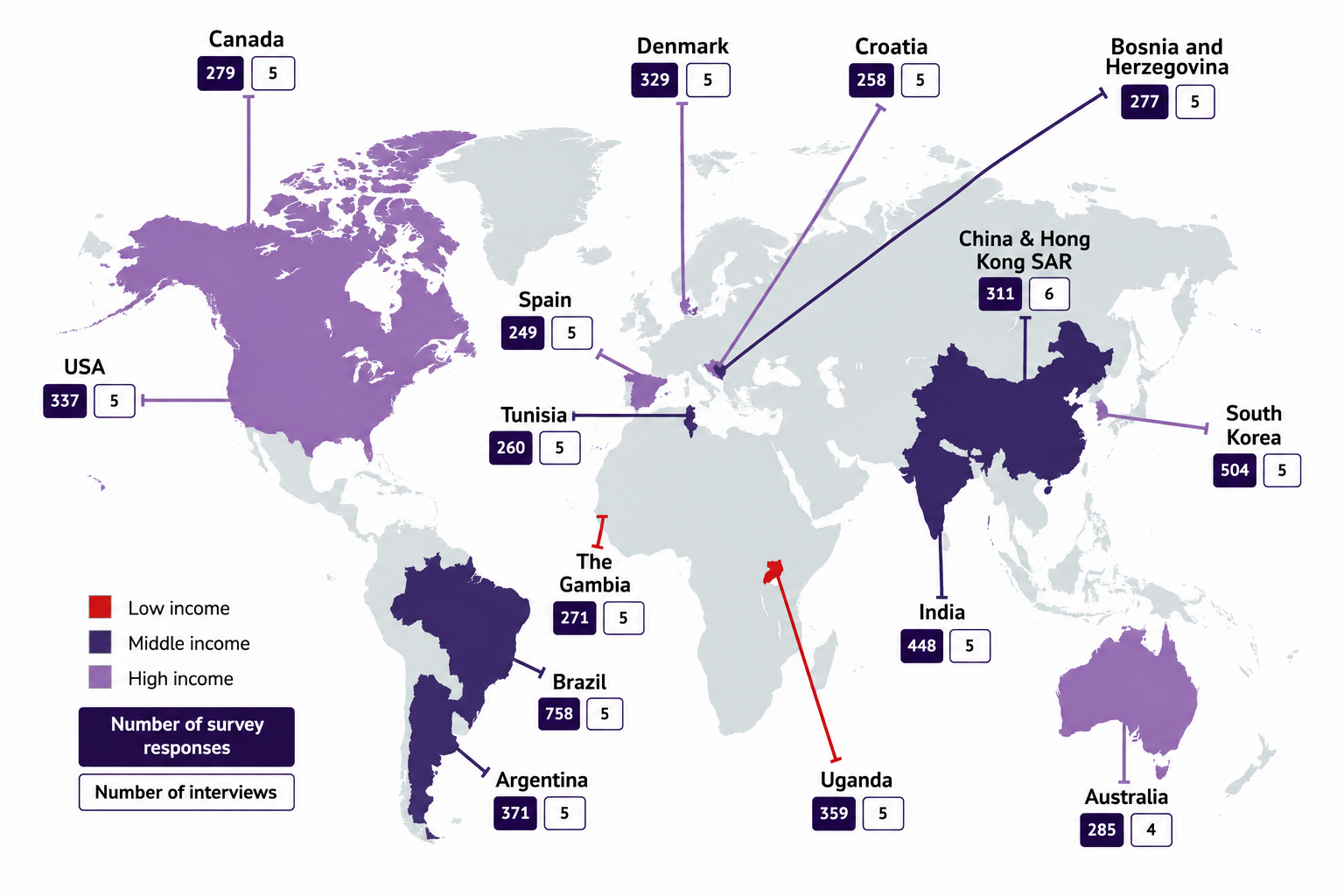
15countries · 6 WHO regions
12languages
The study

Listening to what life with epilepsy is really like

Epilepsy research has long focused on seizures and clinical outcomes. GENS widens the lens — capturing the psychosocial, emotional, practical, and societal impacts of living with the condition.

The Global Epilepsy Needs Study was developed to better understand the real-life experiences, challenges, and unmet needs of people living with epilepsy around the world.

Grounded in lived experience and shaped through global collaboration, GENS aims to inform more person-centred care, stronger advocacy, improved support services, and policies that reflect the realities of everyday life with epilepsy.

The Policy & Advocacy Report distils these findings into ten actionable, cross-cutting recommendations for policy-makers, aligned with the WHO Intersectoral Global Action Plan on Epilepsy and Other Neurological Disorders (IGAP).

Policies, plans, and programmes to address epilepsy as a public health priority are ultimately pointless unless they address the real, everyday unmet needs of people living with the condition.
Dr Francesca Sofia · President, IBE
Global burden

Why this study, now

Epilepsy is the world's most common serious chronic neurological condition — yet the lived realities of more than 50 million people remain under-measured in global health policy.

51.7M
People worldwidelive with epilepsy.
80%
Live in LMICswhere treatment gaps exceed 75% in low-income settings.
Premature mortalitycompared with the general population.
$100B
Annual global economic burdenexcluding lost productivity & earnings.
14.4M
Disability-adjusted life yearsfrom idiopathic epilepsy.
70%
Could become seizure-freewith appropriate antiseizure medication.
25%
Of cases preventablewith the right public-health interventions.
5TH
Among neurological causesof disability-adjusted life years globally.
Sources: WHO IGAP · GBD 2021 · full citations in the GENS Policy & Advocacy Report.
Scale

Overview of GENS

Co-designed with people living with epilepsy, clinicians, and researchers across six WHO regions — the most ambitious research undertaking in IBE's history.

15
countries
12
languages
10
life domains
75
in-depth interviews
5,296
survey responses
Ten life domains

Where epilepsy touches everyday life

GENS asks about the parts of life most often left out of clinical conversations. Each domain is examined through both survey data and lived-experience interviews.

01
Knowledge & Advice
Top needLocal communities need to learn more about epilepsy.
02
Safety & Security
Top needBasic seizure first-aid should be more widely known.
03
Healthcare & Wellbeing
Top needEasier access to healthcare services and epilepsy specialists.
04
Learning & Education
Top needReasonable adjustments during studies or training.
05
Work & Income
Top needPolicies to protect against unfair treatment at work.
06
Transport & Driving
Top needSafe, affordable travel options for people with epilepsy.
07
Community & Household
Top needSocial events that avoid triggers and have first-aid present.
08
Mental Health & Wellbeing
Top needBetter planning between mental-health and epilepsy care.
09
Sexual & Reproductive Health
Top needSimple information for people with epilepsy who want to become parents.
10
Achieving Life Goals
Top needSupport managing fear and anxiety about seizures.
Five major themes

What ran across every domain

Thematic analysis of 75 interviews, combined with survey data, surfaced five overarching themes that recur across the lived experience of epilepsy worldwide.

01
Navigating uncertainty & redefining daily life
The unpredictable nature of epilepsy disrupts routines, increases vulnerability, and forces individuals and families to continually adapt their plans and expectations.
02
Living with risk, social exclusion & misunderstanding
Stigma, judgement, and societal misconceptions shape participation and relationships — often leading to exclusion, withdrawal, and strained connections.
03
Navigating inaccessible systems
Healthcare, education, employment and transport systems often lack the flexibility, resources, or understanding required, leaving people with epilepsy to adapt within inflexible environments.
04
Consequences of inaccessible or inadequate information
A lack of timely, accurate information — at individual, professional, and societal levels — reinforces stigma and limits the ability to make informed decisions.
05
Complex epilepsy needs demand more than standard approaches
People with rare or complex epilepsies face fragmented care pathways, unmet cognitive and emotional needs, and heavy caregiving burdens not addressed by standard models of support.
Cross-cutting recommendations

Ten actions for policy-makers

Global recommendations to be adapted to local contexts — aligned with WHO IGAP targets and broader UN frameworks on sustainable development, NCDs, and human rights.

01
Strengthen human-rights-based frameworks. Ensure non-discrimination and recourse mechanisms when rights are violated.
02
Develop national epilepsy plans — or integrate epilepsy into national neurology, rare-disease, and NCD policies.
03
Run nationwide awareness campaigns focused on stigma reduction and seizure-first-aid training for community gatekeepers.
04
Resource national & community-based organisations to deliver services and supports locally.
05
Ensure meaningful involvement of people with lived experience in policy design, implementation and evaluation.
06
Build integrated, cross-sectoral care systems across health, education, employment, transport, and social protection.
07
Increase health workforce capacity in epilepsy care — including mental health and SRH — leveraging innovation.
08
Guarantee continuous access to essential medicines and services, particularly during conflict and crisis.
09
Advance inclusive urban planning and built-environment design for safety, accessibility, and inclusion.
10
Fund evidence generation — registries, epidemiology, R&D, and socio-economic analyses to inform action.
Participating countries

A global evidence base

Country-specific reports accompany the global findings. To request access to country-level raw data, contact the GENS team.

Map of 15 participating GENS countries with survey response and interview counts, shaded by income classification.
Source: GENS Policy & Advocacy Report. Number of survey responses shown in dark / number of interviews shown in light.
The team

Researchers & experts by experience

GENS was led by IBE in partnership with research partners MediPaCe, members of IBE's Community Council, regional committees, and national epilepsy organisations across six WHO regions.

Authors, collaborators & the chapter working group

30+ collaborators across 15 countries shaped GENS through co-design, fieldwork, translation, analysis, and review.

Naziya AnzariIN Alicia BogaczUY Martin BrodieUK Heather BrooksCA Nicole CoulthardAU Laura DicksonCA Laura Maria de Figueiredo Ferreira GuilhotoBR Anchor HungHK John Nute JabangGM Boram LeeKR Kheng-Seang LimMY Rebecca LisleUK Anita MagoUG Sharon MbuguaKE Bindu MenonIN Sarah NekesaUG Youssouf NoormamodeMU Per OlesenDK Kris PierceAU Dzenana RustempasicBA Jitendra K. SahuIN Ana SrukHR Christa StudzinskiCA Nirmal SuryaIN Maria Alice SusemihlBR Laura WeidnerUS Samuel WiebeCA Andrea WilkinsonUS Leonie WollscheidDE Ada WongHK Bernadette ZappaAU
Download

Read the full report — share it widely

The GENS Policy & Advocacy Report turns the voices of 5,296 survey respondents and 75 interviewees into ten clear actions for policy-makers worldwide. Free to download, translate, and share.

Contact

Get in touch

Press, partnerships, country-data requests, or general enquiries about the Global Epilepsy Needs Study and the Policy & Advocacy Report.

A collaborative research partnership

MediPaCe partnered with the International Bureau for Epilepsy (IBE) to support the design, coordination, and delivery of the Global Epilepsy Needs Study (GENS). As the study's research partner, MediPaCe worked alongside researchers, healthcare professionals, patient organisations, and people with lived experience to help ensure the project reflected the real-world experiences and priorities of the global epilepsy community.

Research partner
With thanks

Thanks to our funding partners

GENS would not have been possible without the generous support of our funding partners, whose commitment makes person-centred epilepsy research a reality.

Our funding partners
Angelini Pharma · Jazz Pharmaceuticals · UCB · Takeda